Tuesday 04 June 2019
I had a bed in a room with three other gentlemen, all of whom looked to be in their seventies and were in far more serious states of health than me. Two of them were receiving radiotherapy treatments and were suffering with a lot of pain and nausea. I don’t know what the third gentleman was in for, but he was on some pretty heavy opioids which made him quite disoriented and forgetful at times.
Before my chemo started, I was given some preliminary drugs. I had one Akynzeo capsule, which is an anti-nausea drug that remains active in the system for five days. I was also given six Dexmethasone steroid tablets. These can help with nausea and inflammation.
After waiting around for a while, I was hooked up to a drip around 16:30. My IV fluids for the session were:
Etoposide – 500 ml over one hour
Etoposide – 500 ml over one hour
Saline – 1000 ml over one hour
Mannitol – 400 ml over half an hour
Cisplatin – 500 ml over one hour
Electrolyte solution – 1000 ml over two hours

At the end of some of the allotted durations, some of the bags still had a little left in them, so a few minutes were added to ensure that all of the fluids had been used. With that extra time, plus the time it took to change the bags, the entire session took around eight hours and finished after midnight.
Bag change times can be variable as it depends who is available to do it. Any nurse is able to change a regular bag of fluids, but two nurses are required when a bag containing chemo drugs is being put in place. The nurse administering the chemo needs to be specifically qualified to do so, and a second nurse is required to check that everything is correct: the correct patient, the correct drug, the correct volume and rate of flow. Consequently, they are continually asking patients to confirm their names and dates of birth.
All of the extra fluid in my system meant having to visit the toilet frequently, roughly once every 500 ml, in my estimation. When doing this, I needed to unplug my IV pump machine from the mains (it has a battery which can handle several hours of use on a single charge) and wheel it to the bathroom with me. Then I had to urinate into a cardboard bottle and leave it for the nurses to collect. They would then measure all of my fluid outputs to compare against my fluid inputs, to ensure that enough was passing through.
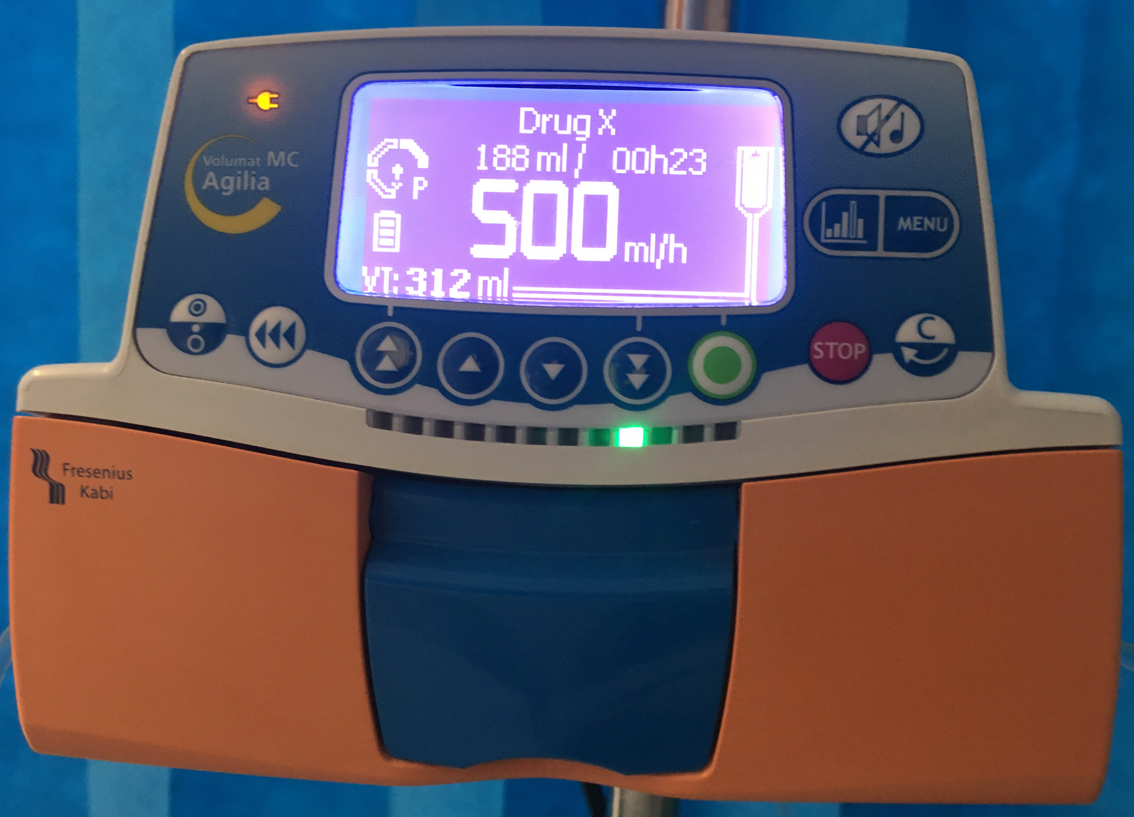
Pia and I had slept less than six hours the previous night and had not had very long sleeps on the previous few nights, so we were both quite tired by the time the chemo started. I felt more and more tired as it progressed and had some headachy symptoms, but nothing too bad. I’d brought my laptop with me so we were able to sit on the bed and watch some films while the fluids were going in. Pia left about half way through the session, before she got too tired for the drive home. After she’d gone, I just felt like sleeping, but remained awake until I was disconnected from the drip.
Once the session was complete, about half past midnight, I fell asleep straight away. I woke up about two hours later to go to the toilet. I had a dry mouth and felt a bit disoriented. I couldn’t get back to sleep after that, so I put on headphones and listened to a couple of guided meditations, which were relaxing. I dropped off again a couple of hours later, after another toilet visit. Between the IV infusions and drinking a lot of water, toilet visits are becoming quite a major daily activity!

 A Journey Through Cancer