BEP Chemotherapy is the usual treatment for germ cell cancer patients who have experienced metastasis. The initials stand for the three chemotherapeutic agents used: Bleomycin Etoposide Cisplatin
These drugs are given individually as intravenous infusions. A typical treatment cycle lasts for 21 days and the drugs are given on the following schedule:
Day 1 – Etoposide and Cisplatin Day 2 – Etoposide, Cisplatin and Bleomycin Day 3 – Etoposide Day 8 or 9 – Bleomycin Day 15 or 16 – Bleomycin
The schedule can vary slightly from that above depending on the patient and treatment centre. Three consecutive cycles are usually prescribed, but four cycles are used in some cases.
There are several side effects that patients might experience during the treatment cycles including: fatigue, headaches, nausea, appetite loss, hair loss, tinnitus, numb toes and finger tips, changes in taste, greasy skin, brittle nails, shivering, fever, mouth ulcers and cold and flu-like symptoms. Some of these can become long-term side effects, but the occurrence of those is fairly low.
There is also a heightened risk of infection in chemotherapy patients, as the treatment tends to lower one’s white blood cell count, particularly the neutrophils which are the body’s first line of defence against infection. For this reason, chemo patients need to keep good hygiene practices and get checked out urgently if they start experiencing high temperatures or other signs of infection.
My first follow-up CT scan was in February 2019. This scan showed some enlargement to a small cluster of para-aortic lymph nodes, which was concerning to my oncologist as it could indicate metastasis. I wasn’t completely convinced though, as there could be numerous reasons for lymph nodes being enlarged. I’d also recently changed some of my supplemental and dietary protocols, including stopping taking some herbal formulae which acted on the lymphatic system. Any of these could have caused some temporary change to tissue in the lymphatic system.
Also prior to the CT scan, my HCG had risen to the upper limit of the normal range (5 IU/L), which seemed to correlate with the lymph node enlargement. However, when measured a week or so after the scan, it had dropped to <1 IU/L. This left me thinking even more that what had shown in the scan was not too concerning.
At this point, to be prudent, I doubled down on how I was eating, what supplements I was taking and how I was looking after myself in terms of exercise and spiritual and emotional wellbeing. I also got in touch with an integrative physician who worked with a lot of cancer patients, and she was able to help me devise a new supplemental protocol, amongst other things. What I was looking to do was get the lymph nodes back to their usual size and shape by the time of my next CT scan three months later.
If anything, this gave me quite a psychological boost and over the three months I found that I was able to be more calm, relaxed and at peace with myself. Even though there was some concern as to what my scan had revealed, I was in a good positive frame of mind and was looking after myself really well.
My next CT scan took place in May 2019. The enlarged lymph nodes had almost doubled in size during the previous three months. There were also a couple of indeterminate spots on my lungs, which were further cause for concern. It wasn’t quite what I’d hoped for, but I was not going to let it get me down. In spite of this, my tumour markers were all normal, but it turns out that they are not necessarily stimulated by metastasised cancer cells.
The suggested treatment for this was a nine-week course of BEP chemotherapy, consisting of three three-week cycles. Chemotherapy was something I’d hoped to avoid. However, the progression of my lymph node enlargement had been quite quick, so it was important that I choose a course of treatment sometime soon, chemo or otherwise. Also, this particular type of chemotherapy had a curative success rate of around 95%, which is phenomenally good. In fact, testicular cancer is one of the very few cancers for which there has been significant improvement in the success of chemotherapy over the past few decades.
Based on the outstanding rate of success, I decided that at this point in my cancer journey I would choose chemotherapy. There are many other treatment options available to cancer patients, which are not necessarily prescribed by the NHS nor most national health systems around the world, and I had looked into many of these. However, on this occasion, I decided that the chemo was the right choice for me.
It was important to me that this felt like a decision that I was making, as it gives me a sense of ownership of my health. I can not imagine that I would have had the same positive mindset going into chemo had I felt coerced into accepting the treatment, or if I had been rushed into it without having had the time to gain an full understanding of all of my options. If there’s anything I could recommend to a patient on the brink of choosing chemo, it would be to make sure that they feel comfortable in whatever treatment decision they make.
A week later, I returned to the hospital to sign a consent form and I was booked in to begin treatment a few days after that.
A few weeks after surgery, in November 2018, I had my first appointment with the Germ Cell Oncology team at the Bristol Haematology and Oncology Centre. They are the specialist unit for testicular cancer in the south-west of the UK.
I was finally given my official diagnosis, based on my CT Scan and the pathology of the tumour that had been removed. My diagnosis was: pT1 stage I combined germ cell tumour (90% classical seminoma, 10% urea ectodermal tumour). My tumour measured 80 mm in length and had grown from the inside of the testicle. The only real testicular tissue that was left was in a thin layer around the tumour. The good news was that my CT scan was clear and no cancer cells had been found in the tissue of any of the surrounding blood vessels.
So it looked like the surgery had done the job. None-the-less, I was to be monitored for the next five years, just to be sure. This would mean monthly visits to the clinic for the first year or so, then progressively less frequent check-ups for the remaining four years.
A monthly check-up would involve a short consultation with either an oncologist or a specialist nurse. I would also have blood taken to check on tumour markers. Chest x-rays and CT scans would be taken every three months.
The tumour markers that are regularly checked for testicular cancer patients are:
AFP: alpha-fetoprotein HCG: Human Chorionic Gonadotropin LDH: Lactate Dehydrogenase
For me, HCG had been notably heightened prior to surgery, with a reading of up to around 180 IU/L. The normal range for HCG is from 0-5 IU/L. The other markers remained largely normal for me both prior to surgery and all three have stayed mostly within normal range since. The only exception to this was LDH, which has shown to be above normal at times, but it is well known that a high LDH reading can be triggered by a number of things that are not tumour-related, which means that it is only a reliable marker if it shows consistent readings.
As a side note, I’d made some changes to how I’d been living since my first visit to the GP in September. I’d stopped drinking coffee and alcohol. I’d also started detoxing using the Dr Morse method, something that I’d been meaning to do for a couple of years but hadn’t previously gotten around to. This meant that I was eating a lot of fruit and vegetables, most of it raw, and I was taking a number of herbal supplements to support the body during detoxification. I continued with this until January 2019, at which point I stopped the herbs and broadened my diet a little. I continued to avoid caffeine and alcohol.
My orchidectomy took place in October 2018. It is an operation performed under general anaesthetic which completely removes a testicle. During the two or three weeks leading up to surgery, my enlarged testicle had grown even more and become noticeable heavier. It wasn’t causing me any discomfort, but it was becoming something of an inconvenient obstacle.
A few days before the surgery, I visited the hospital for a pre-med screening. This was an opportunity for a nurse to check that I was fit for surgery and that there were no risk factors that might cause any issues or reason to delay. The screening predominantly consisted of a long list of questions and checks on blood pressure, heart and lungs.
On the day of surgery, my wife Pia and I arrived at the hospital around 9 am. I started with a CT scan of my chest to groin region. This was to check for any signs of metastasis, or spread, of the cancer. The most common places that metastasis is encountered in testicular cancer patients are in lymph nodes and the lungs. A CT scan is usually performed within a week or so of surgery and aids oncologists in deciding whether or not to recommend any additional treatment (i.e. chemotherapy and/or radiation). I was lucky enough to have my scan scheduled on the morning of my surgery, which saved another trip to the hospital during recovery.
I had a cannula inserted into a vein before the scan. This was so that during the scan I could have a contrast dye injected into my bloodstream. This helps to give more clarity to the scanned images, making it easier to identify any abnormalities. The first attempt to insert the cannula “popped” the vein, but the second attempt was successful.
I’d had a CT scan once before, although many years earlier, so I knew pretty much what was going to happen. I lay on a platform which moved back and forwards through the centre of a large donut shaped machine. I inhaled and held my breath at certain times, as instructed. When the contrast dye is injected, people tend to get particular feelings in the body. I mostly experienced this as a slightly metallic taste and a hot flush. Some people get a feeling that they need to urinate, but I didn’t notice that. It only takes a couple of minutes to complete the scanning.
The scan itself takes a series of images of slices through the body at close intervals. When these are being analysed by doctors, they are viewed on screen in sequence and the analyst can move from slice to slice in either direction, as if watching a video.
In the couple of hours before starting surgery, I had the opportunity to speak with my anaesthetist. She had a long list of questions for me, most of which had been covered during the pre-med screening. I then saw the surgeon who asked me many of the same questions again (it never hurts to ask things multiple times). He also gave me an examination and drew some arrows on my skin to ensure that once I was in theatre, there would be no ambiguity as to which testicle was being removed.
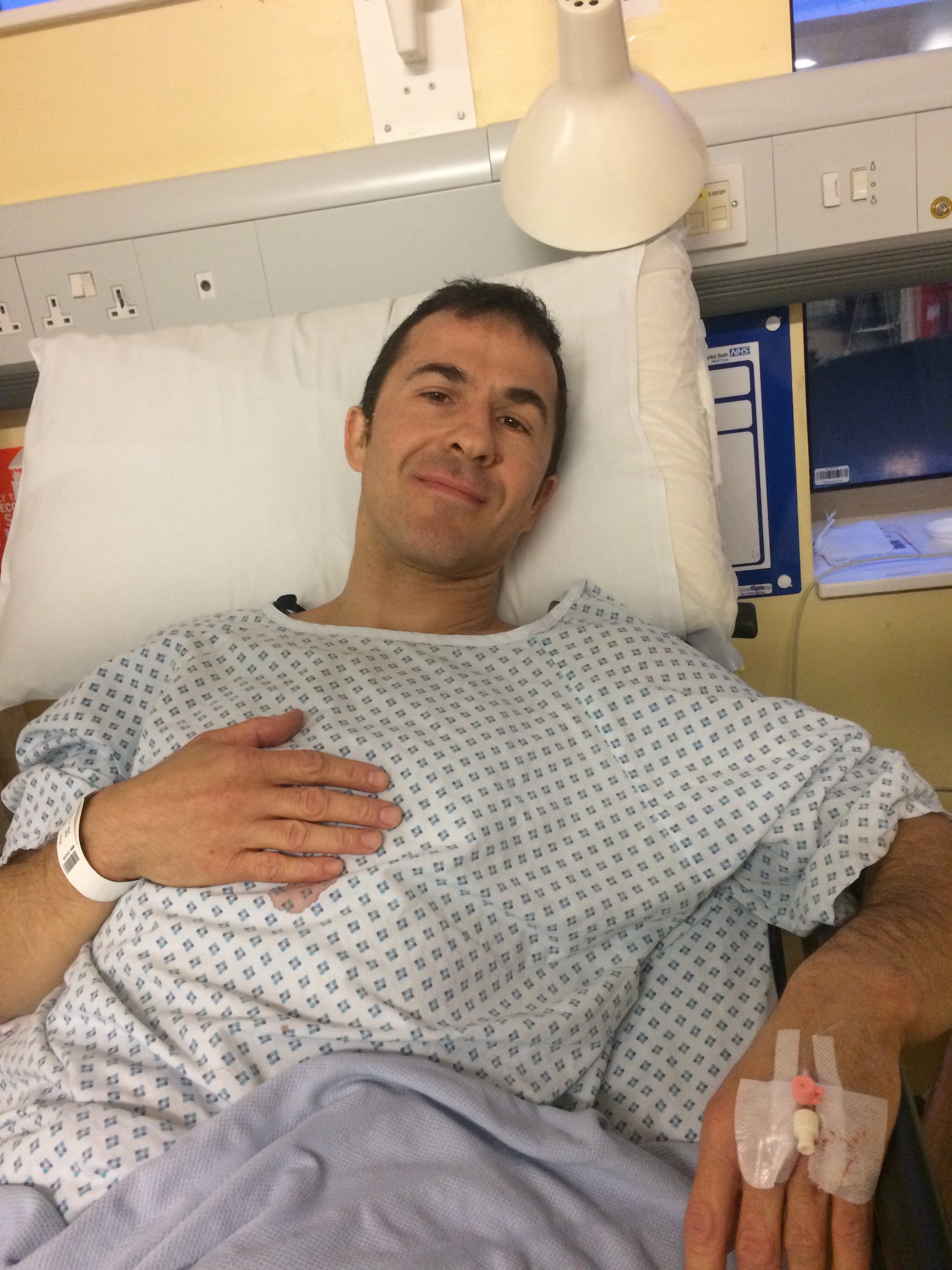
When they were ready for me, I donned a hospital gown and compression socks, and walked through to the theatre. There I met the anaesthetist again and the nurses who would be assisting with the operation. I was positioned on a bed and had a cannula inserted into the back of my hand through which the anaesthetic would be administered. I went through another round of questions to ensure I was the right patient, in for the right operation, and that I was still not knowingly allergic to any drugs, etc. Once I was given the anaesthetic, I was under within about twenty seconds.
The operation took 30-40 minutes. An incision was made in the groin and the testicle was essentially pushed up from the scrotum and popped out. All the connected vessels were tied off and the incision was stitched and glued closed.
I woke up in a recovery room. The anaesthetist was there to see me come around and was on her way after she’d checked that I was alright. She left me in the care of a nurse and I must have stayed there for almost an hour before being moved to a ward, where Pia was waiting for me.
On the ward, recovering after the surgery
With the anaesthetic still in my system, I wasn’t able to move my legs straight away. But over two or three hours that became easier and I could eventually lift each leg independently. Before I could be discharged, I needed to eat and drink a little and also show that I could make a trip to the toilet and provide a urine sample. I drank some water and ate a few pieces of fruit. When it came to making a toilet visit, Pia supported me as I walked. Once I’d finished and turned to wash my hands, I made the mistake of bending my left knee just a little too far and placing too much weight on it. That caused me to collapse, as the residual effect of the anaesthetic meant that I still didn’t have the full strength in my legs. That was a bit of a shock, but fortunately I didn’t hurt myself.
The surgeon also dropped by to see me. He was very happy with how the operation had gone and said that it definitely looked like cancer.
We finally got away and were home around 10 pm.
My recovery from the operation went quite smoothly, although I experienced some severe cramps in my left leg over a number of days. I think that this was due to my leg having caved in when I made my toilet visit before leaving the hospital. I must have caused a little damage. At one point, I had to revisit the hospital to have an ultrasound scan on the veins in my leg to ensure there was no evidence of a blood clot. Fortunately it was all ok.
I also visited my GP a couple of times in the week after the operation to have blood taken to check for changes to tumour markers. My HCG level, which had been very high before the operation, showed progressively lower readings after each new test, which is what would be expected had the operation been a success.
 A Journey Through Cancer