Second Post-BEP CT Scan

In the months following chemo, I tried to look after myself well. I was eating a fairly clean, predominantly vegan diet which was largely organic. I stayed away from alcohol and caffeine, as I’d done for the last year and I continued taking a lot of the supplements that I’d been on, notably curcumin, vitamins C, D3 & K2, some herbal formulae and Chinese mushroom extracts, predominantly from reishi, cordyceps and coriolus. I also continued with BodyTalk every few weeks.

Pia and I attended a really good three-day retreat in October with a group called CancerUCan. The group included a range of people at different stages of their cancer journeys, some who were recently diagnosed, others who had recovered long ago and many in between. There were notably several attendees who had been diagnosed with stage 3/4, or even terminal cancer, who had made full recoveries, often with little to no conventional treatment. It was great to talk to them and to hear how they had navigated through their cancer experiences. We had talks and workshops from a few people including Chris Woollams from CancerActive. It was a very valuable and motivating event.

Towards the end of the year I managed to get a few days of work that I could do from home, which was good, but even 3-4 months after completing chemo, I still wasn’t feeling quite up to travelling for work and being away from home for days at a time. I still found that I couldn’t exert myself beyond a certain point without getting very worn out and this was limiting what I could do.

In early January 2020, I had my second CT scan since completing chemo. I hadn’t expected it to show much, but my oncologist was quite concerned with how it turned out. The residual mass, while looking more uniformly fluid (a good sign), had changed shape and was slightly larger in two of three dimensions. Although the change was small, it was none the less apparent. The immediate concern was that if it continued to expand in the same way then it could start to press on my kidney and impair its function. The advice I was given was to proceed with the RPLND surgery.

I didn’t want to do the surgery. Part of me just wanted to get on with my life and not have another major interruption, but I was also scared. I was scared of having such a major operation, I was scared of things going wrong and I was scared of the side effects of the surgery manifesting. Although I was not completely ruling out any course of treatment, I was just about drawing a line at undergoing RPLND. I wanted to be sure that it was truly worth my while doing it before going ahead.

We went to see the surgeon again to talk things over. He indicated that the surgery would be tricky enough as it is, but that the longer I waited, the harder it would be and the higher the chance that some of the unwanted risks could occur. He gave me a copy of what I consider to be the most complete patient focussed leaflet on RPLND that I’ve read on the procedure. As well as explaining the procedure, the leaflet also gives the approximate risk of various “after-effects”:

Problems with weak or absent ejaculation after the surgeryBetween 1 in 2 & 1 in 10
Accumulation of lymph fluid requiring needle drainage or further surgeryBetween 1 in 2 & 1 in 10
Infection, pain or bulging of the incision requiring further treatmentBetween 1 in 2 & 1 in 10
Temporary problems with delayed bowel function requiring prolonged nasogastric (stomach) tube insertionBetween 1 in 2 & 1 in 10
Need for removal of additional organs on the affected side (usually a kidney, damaged by blockage from the lymph nodes)Up to 1 in 10 patients (10%)
Bleeding requiring transfusion or further surgeryBetween 1 in 10 & 1 in 50
Need for further treatment if we find any residual cancer in the lymph nodesBetween 1 in 10 & 1 in 50
Injury to nearby local structures (blood vessels, spleen, liver, lung, pancreas & bowel) requiring more extensive surgeryBetween 1 in 10 & 1 in 50
Entry into your lung cavity requiring insertion of a temporary drainage tubeBetween 1 in 50 & 1 in 250
Anaesthetic or cardiovascular problems possibly requiring intensive care (including chest infection, pulmonary embolus, stroke, deep vein thrombosis, heart attack)Between 1 in 50 &1 in 250
Peri-operative deathBetween 1 in 100 & 1 in 200

The particular risks that the surgeon was keen to highlight were the possibility of losing a kidney, accumulation of lymph fluid in the abdominal cavity requiring a drain, and the possibility of retrograde ejaculation. Retrograde ejaculation is caused by nerve damage which results in one’s ejaculate being deposited in the bladder rather than following its normal path on orgasm (I read that it can self-correct after a couple of years, but the surgeon said that this wasn’t always the case). It can be quite a touchy subject for many men, particularly those younger than me who haven’t had any children yet but would like to.

I hadn’t really expected the urgency of having this surgery to have escalated quite so quickly, but I realised that it wasn’t going to go away and might just get worse. Based on that, I decided to proceed with the surgery.

Post-BEP Follow Up

I had my first post-chemo CT scan in September 2019, about five weeks after completing my third cycle of BEP. I was due to have an appointment with my oncologist a few days later, however on the morning of my appointment, my specialist nurse called to ask if we could reschedule for a week later as they needed to speak to a surgeon before they could give me full feedback from the scan. That didn’t sound good to me and I asked for some brief details over the phone. The main piece of information I took away was that the mass in my abdomen, which the chemo had been targeting, had made barely any reduction is size.

This completely threw me, as my expectation was that the chemo would have reduced and hopefully eliminated the tumour. My understanding was that surgery was something that would be reverted if chemo failed. This got me feeling rather down for a couple of days, thinking that the chemo had been a complete waste of time and effort. After that, I got together some plans to move onto some non-pharmaceutical treatments and I started to feel a lot more confident.

When Pia and I turned up for the rescheduled appointment, my oncologist started showing us the latest scan. We listened patiently, waiting for the bad news to drop. He explained that the spots on my lungs were no longer present (good start!) and pointed out that the main mass in my abdomen now appeared to be less dense which indicated that it was likely to consist of dead cells. At this point Pia and I needed some clarification. Pia said, “So is this good news?”, to which my oncologist replied, “Oh yes!”. We both burst out laughing, having had out pessimistic expectations turned on their head.

What I had not realised, and I would argue had not been explained to me properly, was that a tumour the size of mine would not be expected to reduce in size. Once a tumour of this type is more than about three centimetres across, the chances of it reducing in size are minimal, even if it has responded well to BEP. My tumour had been closer to six centimetres and so didn’t really stand any chance of getting smaller.

In my case, my oncologist was happy that the chemo had been successful and that the tumour was now a residual mass of dead cells. This news was most elating and I was on quite a high for the next couple of days.

What was recommended though, was to have the mass surgically removed. The reason given for this, was that it could possibly contain mature teratomas, which had the potential to lie dormant but then become active and cause trouble somewhere down the line. Although the surgery was recommended, it was neither deemed to be urgent nor necessarily even required. Many people with residual masses such as mine had continued to live normal lives for decades with no bother. That was reassuring.

After a couple of weeks, Pia and I visited Southmead Hospital in Bristol to speak to a surgeon about the recommended procedure. It is known as retroperitoneal lymph node dissection (RPLND). It is not a trivial operation, but major surgery that involves opening the abdomen down the middle and teasing the sticky tumour tissue away from everything that it is touching, including blood vessels and internal organs. It would involve a hospital stay of around five days and a full recovery would be expected to take three months. The surgery is also not without risks including damage to blood vessels, damage to organs, damage to nerves and the possible loss of a kidney.

Whilst some of these risks seemed small, I didn’t feel that they were risks I was willing to take at that stage, particularly if the surgery was not considered urgent. I was also hoping to start getting back to normal life after several months of disruption to my year, and I didn’t want to be taking another three months out unless I really had to. My oncologist was comfortable with this decision.

I started trying to get back to normal, knowing that there was the possibility of needing to have surgery sometime, but not necessarily any time soon.

BEP Cycle 2 Days 17-18

Thursday 11 – Friday 12 July 2019

I was quite tired on Thursday and took it pretty easy. I was a bit tired and sluggish on Friday as well.

I had an appointment with an oncologist on Friday morning to discuss how I was getting on with the chemo, now that I was near the end of cycle 2, and to have bloods taken to check my tumour markers and full blood count. The oncologist was quite happy with how I was getting on, on the whole, however she was a bit concerned about my cough and the heavy feeling in my chest.

Bleomycin is known to affect the lungs, but we wouldn’t want it to affect my lungs too much. She said that she would arrange for me to repeat the lung function test to see if there had been any degradation. If there was, beyond a certain amount, they would consider stopping giving me Bleomycin. As I’d taken the plunge with chemotherapy and already come this far, I didn’t really want to stop taking something that might be helping to halt the spread of cancer cells. Despite the cough, I was still able to take deep breaths quite easily, so I was fairly confident that the results of the lung function test would be close to normal.

I also asked about the stinging in my urethra. As I’d already had two urine tests which came back negative for infection, the oncologist said that it was probably just a chemo thing. Although it felt quite unbearable at times, I’d been starting to get to grips with it, trying to treat it as a sensation rather than judging it and experiencing it specifically as pain.

Once we got home in the afternoon, I went into the garden to try repotting a couple of plants, but I was quite exhausted and didn’t get very far before having to head inside for a rest. By Friday evening I’d started perking up. We had some friends coming down from London to stay the night, arriving around 8 pm. I decided that I’d get busy in the kitchen and cook some dinner to be ready for when they arrived.

I decided to make a jackfruit curry. We had a few tins of young green jackfruit, but I’d not cooked with it before. I used a recipe for a swede curry as my base and referred to a recipe for jackfruit tacos to ensure I cooked the jackfruit element of it in a suitable way. It turned out pretty well, but I think it could have used some more spices to give the jackfruit a bit more flavour. Everyone enjoyed it.

Jackfruit curry in progress

I stayed up quite late in the end, and was exhausted again by the time I got to bed.

BEP Cycle 1 Days 17-18

Thursday 20 – Friday 21 June 2019

Hair loss had been getting progressively more intense as the week had gone on. There was more hair on my pillow on Thursday morning than there had been the day before. I was also able to pull larger clumps out more and more easily.

By Friday I knew that it was time to just cut it all off to avoid the mess. So I did that, but not before making a short video about what the hair loss experience is like.

A short video on chemo hair loss

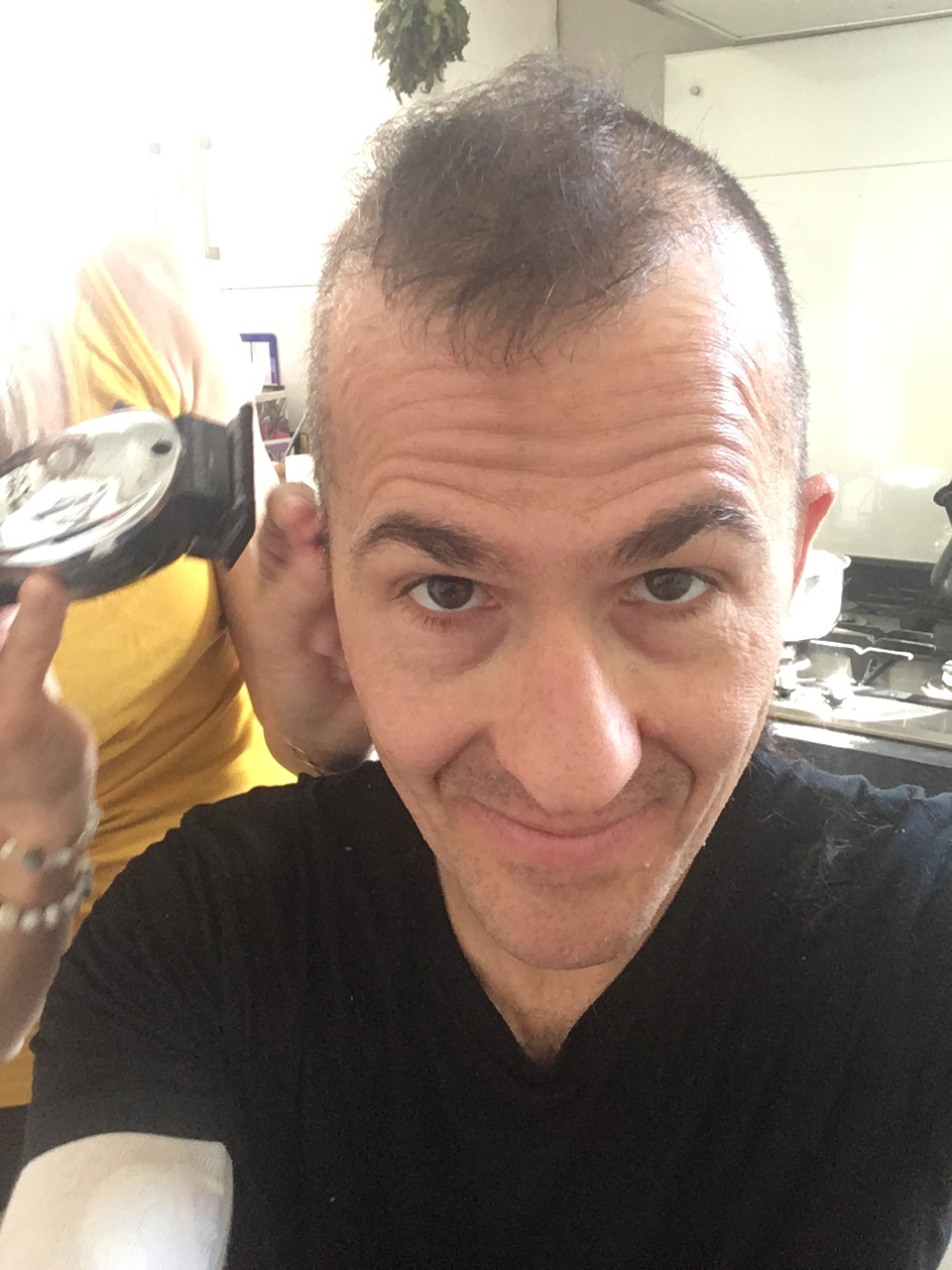
I didn’t shave my head, but Pia used clippers to cut me down to a number one to begin with, then a bit shorter again.

Clipping in progress

We cut it as short as the clippers would allow, then I gave what was left a wash and a good rub down over the bath tub. A lot of small hairs continued to come out as I rubbed my hands over my head. I figured that in a couple more days, they all would have come out leaving me properly bald.

Heading to the hospital, sporting my new look

The next item on my agenda for the day was to get to Bristol for a consultancy appointment with my oncologist. That was a good catch up. We talked about how the treatment had been going and what side effects I had encountered. It turned out that my oncologist was going to be at the Glastonbury Festival the next week, which was cool. We were lucky enough to get tickets for the festival this year, but whilst I’m enduring chemo there would be no way that we’d be camping there as originally intended. Fortunately we only live 25-30 minutes drive from the festival site, so day trips remain a possibility.

I had my usual bloods taken: full blood count and tumour markers. Unfortunately, the only person who could take blood from a PICC line wasn’t there so we had to go for the traditional method of sticking a needle in my arm. I’ve never been a big fan of needles, but with all of the poking and prodding I’d gone through since discovering my enlarged testicle several months earlier, I’d been getting used to them. I also had a urine test in addition to the bloods, as I’d been experiencing stinging in the urethra for a couple of weeks. There was no infection detected.

Before we left the hospital, my specialist nurse introduced another patient to me, a younger guy who would be starting chemo a couple of weeks later. He had a lot of questions and seemed a bit anxious. I started by showing him my PICC line and explained how it worked and what it was like to have put in. Then I talked him through how the chemo would be administered in cycle 1. I think he felt a lot more comfortable after having talked to Pia and I. There was another guy there too who had completed chemo for the same thing a year or so earlier, so he was able to chime in as well.

I was a bit worn out by the time we got home, so I had to rest for a little while. In the evening we visited another half Finnish family that live nearby. They’d invited a few families over for a mid summer party (a very Finnish thing to celebrate). I was feeling pretty tired and slow by this point, but I managed pretty well and had a nice time. We ended up not getting home until after midnight, so not a bad effort!

Background – Metastasis

My first follow-up CT scan was in February 2019. This scan showed some enlargement to a small cluster of para-aortic lymph nodes, which was concerning to my oncologist as it could indicate metastasis. I wasn’t completely convinced though, as there could be numerous reasons for lymph nodes being enlarged. I’d also recently changed some of my supplemental and dietary protocols, including stopping taking some herbal formulae which acted on the lymphatic system. Any of these could have caused some temporary change to tissue in the lymphatic system.

Also prior to the CT scan, my HCG had risen to the upper limit of the normal range (5 IU/L), which seemed to correlate with the lymph node enlargement. However, when measured a week or so after the scan, it had dropped to <1 IU/L. This left me thinking even more that what had shown in the scan was not too concerning.

At this point, to be prudent, I doubled down on how I was eating, what supplements I was taking and how I was looking after myself in terms of exercise and spiritual and emotional wellbeing. I also got in touch with an integrative physician who worked with a lot of cancer patients, and she was able to help me devise a new supplemental protocol, amongst other things. What I was looking to do was get the lymph nodes back to their usual size and shape by the time of my next CT scan three months later.

If anything, this gave me quite a psychological boost and over the three months I found that I was able to be more calm, relaxed and at peace with myself. Even though there was some concern as to what my scan had revealed, I was in a good positive frame of mind and was looking after myself really well.

My next CT scan took place in May 2019. The enlarged lymph nodes had almost doubled in size during the previous three months. There were also a couple of indeterminate spots on my lungs, which were further cause for concern. It wasn’t quite what I’d hoped for, but I was not going to let it get me down. In spite of this, my tumour markers were all normal, but it turns out that they are not necessarily stimulated by metastasised cancer cells.

The suggested treatment for this was a nine-week course of BEP chemotherapy, consisting of three three-week cycles. Chemotherapy was something I’d hoped to avoid. However, the progression of my lymph node enlargement had been quite quick, so it was important that I choose a course of treatment sometime soon, chemo or otherwise. Also, this particular type of chemotherapy had a curative success rate of around 95%, which is phenomenally good. In fact, testicular cancer is one of the very few cancers for which there has been significant improvement in the success of chemotherapy over the past few decades.

Based on the outstanding rate of success, I decided that at this point in my cancer journey I would choose chemotherapy. There are many other treatment options available to cancer patients, which are not necessarily prescribed by the NHS nor most national health systems around the world, and I had looked into many of these. However, on this occasion, I decided that the chemo was the right choice for me.

It was important to me that this felt like a decision that I was making, as it gives me a sense of ownership of my health. I can not imagine that I would have had the same positive mindset going into chemo had I felt coerced into accepting the treatment, or if I had been rushed into it without having had the time to gain an full understanding of all of my options. If there’s anything I could recommend to a patient on the brink of choosing chemo, it would be to make sure that they feel comfortable in whatever treatment decision they make.

A week later, I returned to the hospital to sign a consent form and I was booked in to begin treatment a few days after that.

Background – Monitoring

A few weeks after surgery, in November 2018, I had my first appointment with the Germ Cell Oncology team at the Bristol Haematology and Oncology Centre. They are the specialist unit for testicular cancer in the south-west of the UK.

I was finally given my official diagnosis, based on my CT Scan and the pathology of the tumour that had been removed. My diagnosis was: pT1 stage I combined germ cell tumour (90% classical seminoma, 10% urea ectodermal tumour). My tumour measured 80 mm in length and had grown from the inside of the testicle. The only real testicular tissue that was left was in a thin layer around the tumour. The good news was that my CT scan was clear and no cancer cells had been found in the tissue of any of the surrounding blood vessels.

So it looked like the surgery had done the job. None-the-less, I was to be monitored for the next five years, just to be sure. This would mean monthly visits to the clinic for the first year or so, then progressively less frequent check-ups for the remaining four years.

A monthly check-up would involve a short consultation with either an oncologist or a specialist nurse. I would also have blood taken to check on tumour markers. Chest x-rays and CT scans would be taken every three months.

The tumour markers that are regularly checked for testicular cancer patients are:

AFP: alpha-fetoprotein
HCG: Human Chorionic Gonadotropin
LDH: Lactate Dehydrogenase

For me, HCG had been notably heightened prior to surgery, with a reading of up to around 180 IU/L. The normal range for HCG is from 0-5 IU/L. The other markers remained largely normal for me both prior to surgery and all three have stayed mostly within normal range since. The only exception to this was LDH, which has shown to be above normal at times, but it is well known that a high LDH reading can be triggered by a number of things that are not tumour-related, which means that it is only a reliable marker if it shows consistent readings.

As a side note, I’d made some changes to how I’d been living since my first visit to the GP in September. I’d stopped drinking coffee and alcohol. I’d also started detoxing using the Dr Morse method, something that I’d been meaning to do for a couple of years but hadn’t previously gotten around to. This meant that I was eating a lot of fruit and vegetables, most of it raw, and I was taking a number of herbal supplements to support the body during detoxification. I continued with this until January 2019, at which point I stopped the herbs and broadened my diet a little. I continued to avoid caffeine and alcohol.